
Call us now :08045800815
 Send Inquiry
 Send Inquiry
Potassium Carbonate Granular
Potassium Carbonate Granular Specification
- Ph Level
- Strongly alkaline (pH > 11, in aqueous solution)
- Smell
- Odorless
- Solubility
- Soluble in water, insoluble in alcohol
- HS Code
- 28364000
- Molecular Formula
- K2CO3
- Poisonous
- Non-poisonous
- CAS No
- 584-08-7
- Appearance
- White Granules
- Purity
- 99% min
- Grade
- Industrial Grade
- Physical Form
- Granular
- Molecular Weight
- 138.21 g/mol
- Melting Point
- 891C
- Storage
- Store in a cool, dry, well-ventilated area, away from moisture and acids
- Properties
- White, odorless, hygroscopic solid; readily soluble in water, gives a strongly alkaline solution; non-flammable
- Shelf Life
- 2 years (when properly stored)
- Taste
- Alkaline, bitter
- Usage
- Used as a buffering agent, drying agent, and raw material for other potassium compounds
- Application
- Glass manufacturing, soaps & detergents, water treatment, chemical synthesis, food additive (E501), textile processing
- Product Type
- Alkali
- Structural Formula
- K2CO3
- EINECS No
- 209-529-3
- Ingredients
- Potassium carbonate (K2CO3)
- Shape
- Granular
- Density
- 2.43 Gram per cubic centimeter(g/cm3)
- Precaution
- Avoid contact with skin and eyes; wear suitable protective equipment
- Granule Size
- 2-4 mm
- pH (5% Solution)
- 11.5 12.5
- Stability
- Stable under normal conditions
- Packaging
- 25 kg or 50 kg HDPE bags with inner liner
- UN Number
- Not regulated as dangerous goods
- Free Alkali Content
- 0.5% max
- Chloride Content (Cl)
- 0.01% max
- Iron Content (Fe)
- 0.005% max
- Main Export Markets
- Asia, Europe, Middle East, Africa
- Ecological Information
- Non-hazardous to the environment under normal handling
About Potassium Carbonate Granular
The offered Potassium Carbonate Granular is a chemical compound having a formula (K2CO3). It is a white salt and can completely be dissolved into water that forms a strongly alkaline solution. The provided carbonate granular is pure and efficacious chemical. And therefore, the demand for this product is exponentially increasing day by day. We provide the Potassium Carbonate Granular in preventative packaging that retains the efficacy of the chemicals for the prolonged duration. Furthermore, our clients can get this chemical from us at the market leading price.
Physical and Chemical Properties
| Physical state and appearance | White Solid. (Powdered solid. Deliquescent solid.) |
|---|---|
| Odor | Odorless. |
| Boiling Point | Decomposes |
| Melting Point | 891C (1635.8F) |
| Specific Gravity | 2.29 (Water = 1) |
| Solubility | Soluble in cold water. |
| K2CO3(Total alkali as K2CO3),% | 99.85 |
| KCI, % | 0.006 |
| Fe, % | 0.0001 |
| KOH, % | 0.19 |
| Na2CO3, % | 0.23 |
| K2SO4, % | 0.002 |
| Water, % | 0.1 |
| Heavy metal as Pb, ppm | 1.5 |
Versatile Industrial Applications
Potassium Carbonate Granular serves diverse industries, such as glass manufacturing, detergents, chemical synthesis, textiles, and the food sector where it is approved as a food additive (E501). Its high purity and strong alkalinity make it valuable as a buffering and drying agent, as well as a precursor for other potassium compounds. The granular form enhances ease of handling and metering in industrial processes.
Safe Storage and Handling
This compound is stable under normal storage conditions, with a shelf life of up to two years when kept in a cool, dry, and well-ventilated areapreferably away from moisture and acids. Proper protective equipment, including gloves and goggles, should be used to prevent skin and eye contact during handling, as it is strongly alkaline.
Export-Ready Packaging and Compliance
Supplied in 25 kg or 50 kg HDPE bags with inner liner, Potassium Carbonate Granular is distributed primarily from India to Asia, Europe, the Middle East, and Africa. It is non-hazardous to the environment during standard handling, not classified as dangerous goods, and meets international transport and safety requirements.
FAQs of Potassium Carbonate Granular:
Q: What are the main uses of Potassium Carbonate Granular in industry?
A: Potassium Carbonate Granular is widely used in glass manufacturing, soap and detergent production, water treatment, chemical synthesis, textile processing, and as a food additive (E501). Its strong alkalinity and high purity make it suitable for these diverse applications.Q: How should Potassium Carbonate Granular be stored to maintain its quality?
A: It should be stored in a cool, dry, well-ventilated location, away from moisture and acids. Proper storage helps maintain the products quality and ensures its shelf life of up to two years.Q: When is personal protective equipment necessary during handling?
A: Protective gloves and goggles are recommended whenever handling Potassium Carbonate Granular to avoid contact with skin or eyes, as it is strongly alkaline and can cause irritation.Q: What is the process for dissolving Potassium Carbonate in water?
A: Add the granular material gradually to water while stirring to ensure complete dissolution and to prevent splashing, as it is highly soluble and produces an alkaline solution. Use appropriate personal protective equipment during this process.Q: Where is Potassium Carbonate Granular commonly exported from and to which regions?
A: This product is distributed from India and exported to key markets in Asia, Europe, the Middle East, and Africa, primarily for industrial and commercial uses.Q: What benefits does the granular form offer compared to powders?
A: Granular Potassium Carbonate is easier to handle, meter, and transfer, which minimizes dust generation. This facilitates safer and cleaner operations in manufacturing processes.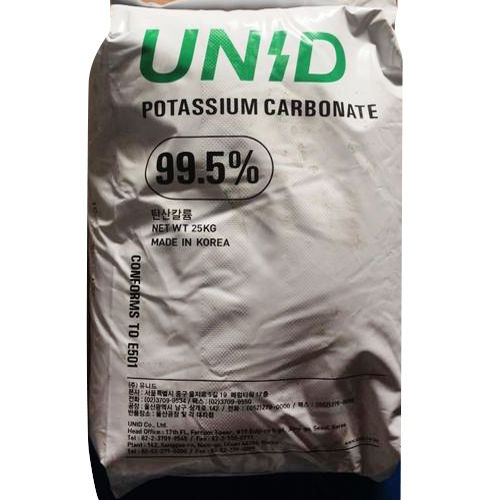
Tell us about your requirement

Price:
Quantity
Select Unit
- 50
- 100
- 200
- 250
- 500
- 1000+
Additional detail
Mobile number
Email

More Products in Speciality Chemicals Category

Propylene Glycol Tech
Application : Other , Used in antifreeze, coolant, plasticizer, humectant, cosmetics, food industry, pharmaceuticals
Taste : Other, Slightly sweet
Usage : Solvent, carrier fluid, viscosity control agent
Ingredients : Propylene Glycol (C3H8O2)
EINECS No : 2003380
Shape : other, Liquid
Hydroxylammonium Sulfate
Application : Used in organic synthesis reducing agents and photographic developing, Other
Taste : Other, Slightly acidic
Usage : Industrial applications chemical synthesis and material processing
Ingredients : Hydroxylammonium and Sulfate ions
EINECS No : 2331188
Shape : other, Granular


 Send Inquiry
Our Products

B/126, Ghatkopar Industrial Estate, Behind R-City Mall, Off. L.B.S. Marg, Ghatkopar (W),Mumbai - 400086, Maharashtra, India

Mr. Sudhir Mehta
(JMD)
Mobile :08045800815
Mr. Hitesh Mehta
(CMD)
 Send Inquiry
 Send SMS
Developed and Managed by Infocom Network Private Limited.
